Baking Bread with Farmer Ground Flour
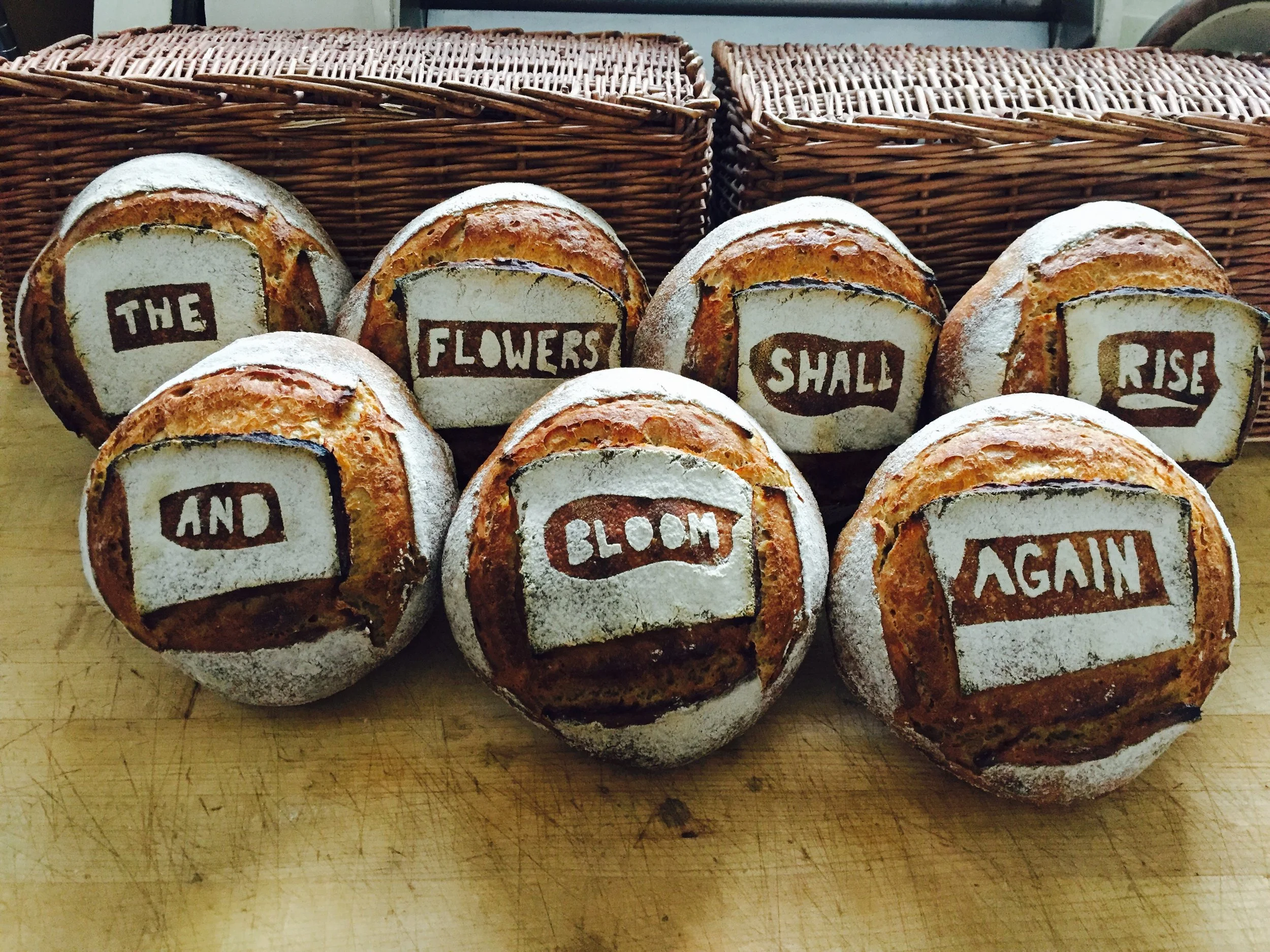
Courtesy of Wide Awake Bakery
By: Stefan Senders
In our bakery we have learned, mostly by trial-and-error, how to bake breads from grains grown and ground in New York State, and in particular, with Farmer Ground Flour. We want our breads to look inviting, to smell delicious, to feel good in the mouth and hand, and most of all, to taste fabulous. We don’t reach these goals every time, but we come close.
We began our baking with top-quality white flours milled from hard wheat grown on the western plains. These flours are “strong,” and they are extremely forgiving; a little extra time in the mixer, a little more or less water, a longer or shorter proof—the bread still comes out fine. When we began working with Farmer Ground Flour, we suffered some spectacular failures. We realized that we needed to approach our baking with more precision and careful observation.
There is little new to be said about baking bread; baking is a simple, if subtle, process, and its basic elements have not changed in centuries. The grain must be ground, and the resulting flour must be combined with water and some form of leavening, provided with energy in the form of mixing, fermented for some period of time, divided into loaves, and baked. It’s that simple.
We’ve pulled together this description of what we’re calling “best practices.” We didn’t invent any of these things; they are what good bakers have been doing for years, and you will find them described by other bakers and in other publications. From our perspective it’s worth thinking about how to approach each step in ways that make success likely. Local flours can be a challenge, and there is no need to make your work more difficult by rushing them or asking them to do things they can’t do. We’ve written this all out as a step-by-step guide, punctuated by “axioms”—the things that are at the core of best practices.
-
Most of the bread eaten in the United States is produced in industrial bakeries. With a few exceptions, industrial baking processes are merely cost-efficient variants of traditional techniques. The grain, instead of being ground between stones, is pressed and stripped into flour between a series of steel rollers; in the bakery, the dough is no longer mixed by hand, but is instead mixed by high-speed mixers, often in controlled-atmosphere environments; leavening, instead of being supplied by sourdough bacteria or prefermented yeast mixtures, is added late in the mix, and primarily for “flavor,” rather than for leavening itself; dividing and scaling is done by high-volume machines, and shaping and baking takes place in large tunnel ovens with precisely controlled temperature and moisture zones. Because so much modern baking is done by machine, and because machines do best when they can do the same thing over and over again, flour for industrial baking needs to be consistent, industrially consistent. When flour does not function well in the machine environment, manufactures routinely add chemicals to make the dough more amenable to machine-handling; strengtheners, relaxers, bleaches, retarders, preservatives, colorants—all manner of additives are used to bring the flour into compliance with the modern bakery environment.
To bake with local organic flour can be a challenge. Because we live and work in NYS, not Kansas, much of our wheat comes from relatively small farms, not the vast fields of the former prairies. Even on a single farm there can be tremendous differences in micro-climate and soil conditions; as a result, the baking quality of wheat can vary markedly from one milling to another. In short, all flour varies in its properties, but flour milled from wheat that has been bred and blended for uniformity is naturally more predictable for the baker.
Local flours have advantages for many bakers: whole-grain flours, which can become rancid if stored for long, are available freshly milled; different varieties of wheat have different flavor and fermentation characteristics, and these can become part of the baker’s creative palette; local grain work is critically important for the sustenance of the local food economy, allowing the baker to be more socially and politically active; local grain baking keeps money in the local economy; the sensitivity required for high-quality baking with local grains enriches the baker’s life, and thus the life of the entire community. There are lots of reasons to celebrate the return of local grains to our lives!
To bake well with local grains requires no special tools and no special skills; it is simply a matter of doing what is best for the bread. Luckily, it’s no mystery.
In the simplest terms, good bread demands only a few things: accurate scaling and division, proper hydration and mixing, full fermentation, gentle but persuasive shaping, considered scoring, a full bake at appropriate temperature and moisture level, and adequate cooling. That’s it. Honestly though, it’s a lot to take account of, and you should expect to take some time mastering each step, no matter how simple they seem.
-
HIGH EXTRACTION WHEAT: Farmer Ground’s High Extraction Wheat flour is our foundation flour, and we use it in most of our breads. In miller-speak, “extraction” refers to the ratio of wheat going into the mill to the flour coming out. A whole-wheat flour, in which all the grain that goes into the mill comes out as flour, is a 100% extraction flour. If only half of what went in were to make it to the flour bag, it would be a 50% extraction flour. To make High Extraction flour, Greg, the miller, takes whole wheat kernels and grinds them into whole wheat flour. That flour is then sifted to remove approximately 20% of the bran and larger particles. The sifted flour is then sent back through the mill will more whole grain. The resulting flour is 85% extraction, and it has a lovely off-white to brown color. The flour ferments actively and aromatically, and it is generally strong and easy to work with.
The High Extraction flour is a great one to start with, and it is perfect for classic French breads. It’s our favorite.
WHOLE WHEAT: Farmer Ground’s Whole Wheat flour is exactly what you would expect it to be: 100% extraction wheat flour. It’s significantly darker than the High Extraction flour, and when fully baked it is extremely flavorful. The flour ferments very quickly, and, as with most whole-wheat flours, the high bran content can reduce the final volume of the loaves.
ALL-PURPOSE: The All-Purpose flour is milled with much the same process as the High Extraction, but it is milled from soft wheat, which is lower in protein. The All-Purpose flour can be quite delicate, and it is likely better suited to quickbreads and chemically leavened breads than to long-fermented loaves. We have made many lovely loaves with All-Purpose flour, but the doughs take gentle handling to keep them from tearing.
SPELT: Farmer Ground Whole Spelt flour is a wonderful thing, and we use it in mixtures with other flours, and in our 100% spelt bread. The flour is highly absorbent, so you can expect to use more water than usual, and the spelt dough feels silky and strong in the hand. Be aware, though, that during the fermentation process the dough will lose much of its elasticity, and it will become highly extensible. As a result, it can be difficult to shape hearth loaves from 100% spelt flour; we make our 100% spelt breads in pans, and they do very well.
RYE: Farmer Ground Rye flour is another staple in our bakery. We use it in our German- and Scandinavian-style rye breads, and mixed with other flour to make our Pain au Levain and our Bauernbrot. Farmer Ground Rye is 100% whole rye, unsifted. When we need a finer rye flour we sift it ourselves in the bakery. We have seen significant variation from batch to batch as different fields have been harvested and delivered to the mill. Rye is hardy, but it is sensitive to growing conditions. In the bakery, rye behaves very differently than wheat. The doughs are sticky, dense, and they have none of the elasticity of the wheat doughs. You will want to take time with your rye, getting used to it, and becoming sensitive to its needs. It’s a rewarding process, as the breads can be delicious!
-
How is Farmer Ground Flour different from the flour you are currently using, and how will you want to change your baking for the best results? It’s likely that you generally bake with a roller-milled wheat flour that has an extraction rate of between 50 and 60%. The flour is probably around 12% protein, and it is likely a little off-white in color. The flour particles themselves are very fine, and the flour homogeneous. It is unlikely that your flour has been bleached, bromated, or heat-treated, but it does probably contain additives including vitamin and mineral “enrichment,” amylase enzymes (usually in the form of barley malt), and occasionally, ascorbic acid.
Farmer Ground Flours are all stone-ground, meaning that they are the produced by crushing the wheat kernels between two rotating mill-stones. Some Farmer Ground Flours are produced in a hammer mill, which, as the name suggests, consists of a set of small hammers that crush the wheat kernels into flour. Both of these processes convert the entire kernel into flour, and both distribute the vitamins, oils, and minerals contained in the wheat germ and in the outermost layer of the seed throughout the flour.
Farmer Ground Flours that are whole-grain, or 100% extraction, consist of the nothing more than the ground grain. These flours include “Whole Wheat,” “Whole Spelt,” and “Whole Rye,” among others.
Farmer Ground Flour also makes flours that are lighter than whole-grain flour. These flours are produced by “bolting” or sifting the flour as it exits the mill, resulting in flour with fewer large particles of bran. Farmer Ground Flour’s “High Extraction Flour” is an excellent example of this kind of bolted flour. The High Extraction Flour is approximately 85% extraction, meaning that 15% of the initial mill run has been removed from the flour. The particle size of this flour is more uniform than that of Whole Wheat Flour, and its color is significantly lighter. In comparison to commercial “white” flour, Farmer Ground’s High Extraction Flour is darker in color, the dominant particle size is slightly larger, and particles of bran and germ are plainly visible. The protein level varies from run to run; usually it is in the 10-12% range, although the upper and lower protein levels are managed by blending wheat at the mill. Farmer Ground Flour contains no additives of any kind: no enrichment, no enzymes or malt, and no ascorbic acid. Nor has it been treated in any way.
Farmer Ground Flour, because it is a stone-milled flour, contains wheat germ oil, and like any oil, wheat germ oil is subject to oxidation and rancidity. This means that Farmer Ground Flours are best when relatively fresh, and they benefit from cold storage if they are not being used up quickly.
Flour is an extremely complex material, and honestly, it is not well understood—by anyone! We do know that when good baking wheat is milled into flour, that flour will perform well in the bakery if it is used immediately. The quality of the gluten will be high, and the dough will respond well in fermentation, on the table, in the hand, and in the oven. If the flour is allowed to sit for some days, its baking quality will begin to fall precipitously, and after about ten days, it may be quite difficult to work with indeed.
Luckily, if the flour continues to age, it will actually regain its strength and baking qualities! For the home-baker this kind of change is rarely an issue; the flour is rarely used immediately, and it has usually aged sufficiently in the distribution process that it performs consistently. For the professional baker, however, the changing quality of the flour can be a challenge; the baker needs to have either fresh or aged flour on hand as needed. Disruptions in supply or storage management can lead to difficult baking. We monitor our usage carefully, and we keep a supply of aged flour ready to back-up our incoming fresh flour. We are also careful to keep old and new stock distinct and well-labeled.
Farmer Ground Flour may also ferment differently than the commercial white flour you are currently using. Because it is rich in oils and naturally occurring vitamins and minerals, Farmer Ground Flour often ferments quickly and vigorously. Similarly, the enzyme activity in Farmer Ground Flour is often more vigorous than that found in commercial flours. For the home-baker, these differences will require only slight changes in process; for example, added sugar is rarely, if ever, necessary for good leavening, and the quantity of leaven may have to be reduced. For the professional baker, the differences can require significant changes in production timing and formulas, and at least at first, the baker will have to pay special attention to the fermentation of each batch of dough.
Farmer Ground Flour, even when it contains the same protein level as commercial white flour, is not as “strong,” and it will require a watchful baker with a gentle hand. At our bakery we do not use dividing or shaping machines, but we would imagine that in a more heavily machine-oriented bakery, Farmer Ground doughs would require particular attention as they move through the process. Dough handling machines that are rough with the dough, or that depend on extremes in dough elasticity or extensibility, will not, we suspect, do particularly well with Farmer Ground Flour.
Farmer Ground Flours, in our experience, make astonishingly good sourdough breads. In part, we think, the acids produced in the sourdough fermentation bring additional strength to the dough, making it easier to work with and more forgiving, and the high mineral content of the flour allows the acidity of the dough to reach relatively high levels before fermentation slows.
So what do bakers need to do to get the best results from Farmer Ground Flour? Here’s how we see it: over the years, bakers have developed techniques for making excellent bread from their local flours. At the same time, many of us, having grown accustomed to high-strength white flours and high levels of yeast, assume that our flour should do our bidding without asking much in return.
We may have to change our approach: to get the best results from Farmer Ground Flour, take care with your baking: strive for accuracy, consistency, and focus, and work to become ever more sensitive to your flour, your dough, and your bread. If you are a home-baker, this kind of focus is likely not difficult to incorporate into your bread-baking. If you are a professional baker, however, you may have to make space in your production schedule to modify your practices and process—which can be difficult to do.
The payoff, we think, makes it worth the effort. If you can’t make what appear to be radical changes in your baking process, try a gradual approach. Increase the proportion of Farmer Ground Flour in your formulas gradually, starting with, say, 5% of the total flour weight and increasing the proportion over a period of weeks. Keep close watch on the dough and the bread as you make the changes, and adjust your temperatures and timing accordingly. In other words, start small, pay attention, and create conditions that make success likely!
-
AXIOM: HAVE THE RIGHT EQUIPMENT ON HAND
You will need the following:
a) A good scale or scales with sufficient accuracy for your needs.
b) A calculator.
c) A pen or pencil and paper.
AXIOM: WEIGH YOUR INGREDIENTS
Most home-bakers and many professional bakers measure ingredients by volume. Don’t do it. If you measure by volume, any variation in flour characteristics will be far overshadowed by variation among batch formulas. You can try the experiment for yourself: measure three “cups” of flour and weigh each one. You will see how much they vary. If you use a cookbook that gives measurement in volume, first, write a letter of complaint to the author, then weigh samples of the given volumes and take the average. Finally, rewrite the formula by weight. We have attached a “cheat-sheet” of volume to weight conversions for flour, salt, yeast, and water. Good scales are cheap and easy to come by. Get one, or two. We use three.
AXIOM: USE THE METRIC SYSTEM
Bread formulas are best understood as ratios—for “so much” flour, use “so much” water and “so much” salt, etc. Thinking of formulas as ratios makes it easy to make large and small batches from the same formula. Consider a simple bread formula:
Flour: X
Water: (.66)X
Salt: (.02)X
Yeast: (.001)X
We could write this formula in a general way like this:
Flour: 100%
Water: 66%
Salt: 2%
Yeast: 1/10th of 1%
This formula says, in essence, “for any given quantity of flour, add 66% of the flour-weight in water, 2% of the flour-weight in salt, and 1/10th of 1% of the flour-weight in yeast. Want a railroad car full of bread? Easy to do. How about a single loaf? Just as easy.
This ratio system is called “BAKER’S MATH” or “BAKER’S PERCENTAGES,” and it’s worth becoming familiar with it. If you are working with pounds and ounces, baker’s math can be very complicated. To make it simple, do it in METRIC. For example,
Flour: 1000g
Water: (.66) x 1000g = 660g
Salt: (.02) x 1000g = 20g
Yeast: (.001) x 1000g = 1g
Want a bigger batch? Just increase the flour-weight:
Flour: 15kg (15,000g)
Water: (.66) x 15,000g = 9900g
Salt: (.02) x 15,000g =300g
Yeast: (.001) x 15,000g = 15g
It won’t take long to determine how many kilos of flour you require for your own baking projects. If you are not used to using the metric system, you may think this is all added complication. It’s not. It is SO MUCH EASIER to scale your formulas using the metric system, and even if it seems daunting, it is SO EASY TO LEARN, that we recommend strongly that you take it on. It will pay off in the quality of your bread.
AXIOM: SCALE YOUR SALT SEPARATELY AND PRECISELY
All your bread formulas will contain salt, and it matters very much that the amount of salt is correct. Salt has powerful effects on bread: it stiffens dough, slows fermentation, increases crust color, and, up to a point, enhances flavor. In most cases you will add the salt late in the mixing process, so it’s important that you don’t mix it with the flour at the outset. The amount of salt required for bread is remarkably small: approximately 2% of the total flour-weight, and tolerances are tight. Get it right.
AXIOM: TAKE YOUR TIME, BE PRECISE, DOUBLE-CHECK YOUR WORK, AND WRITE IT DOWN!!
-
Leavening is what gives bread its lift. Leavenings can be chemical or biological. Chemical leavens include, for example, baking soda and baking powder. Biological leavens include yeasts and bacteria. Most bread bakers work with biological leavens, and the breads they produce are considered to be either “yeasted,” “sourdough,” or some combination of the two.
Yeasted breads are leavened by strains of yeast that have been produced and purified in an industrial process. Yeast is available in a number of forms, including “fresh,” “dried,” and “instant.” In our bakery we generally use instant yeast because it is convenient for us; modern yeast is extremely reliable, and you will want to experiment with different kinds of yeast to see what works best for you.
Sourdough or bacterial leavens are generally produced locally by cultivating wild microbes, although refined sourdough cultures are available from yeast manufacturers. Sourdough cultures, which include bacteria and wild yeasts in varying proportions depending on how they are maintained and used, make particularly flavorful breads, and they are not difficult to work with. One easy way to improve the quality of your bread is to become familiar with sourdough leavening.
Yeasted and sourdough leavenings cause fermentation, transforming the simple paste of flour and water into a light and airy dough, ripe with complex aromas. Dough fermentation is a complicated process, but in its simplest form, microbes metabolize sugars in the dough, and produce from them a mixture of acids, alcohol, and carbon-dioxide gas. The acids and alcohol are a major source of bread’s flavor, and the carbon-dioxide is the source of its lightness. The acids also serve to strengthen the gluten, which traps the carbon dioxide, causing the bread to rise. In any fermenting bread, the mix of fermentation agents—whether they are yeasts or bacteria—as well as their number and maturity, shapes the flavor profile of the resulting dough. The best way to become a better baker is to become a better fermenter. Pay attention to your microbes and give them what they want!
AXIOM: STUDY FERMENTATION AND KEEP YOUR MICROBES HAPPY!
One simple way to improve your bread is to use a smaller initial inoculation of leavening. Instead of adding large quantities of yeast, create a “pre-ferment” from the flour you have scaled for your bread, and use the pre-ferment to leaven the final dough. A pre-ferment is nothing more than a portion of the flour that is allowed to ferment before being added to the mix. Pre-ferments have many names and varieties: biga, barm, levain, sponge, poolish, etc., and each type will have specific effects on the final dough. You will want to practice with different types of pre-ferment to see how they work for you, in your baking environment. From our perspective, the important thing is that PRE-FERMENTS MAKE FOR BETTER BREAD.
AXIOM: USE A PRE-FERMENT.
It makes sense to use a pre-ferment. The resulting breads have better flavor and better keeping quality. But pre-ferments can be challenging, too. You will need to plan ahead, and to have a good understanding of the effects of your particular environment on the fermentation process.
In our bakery, we generally use between 12% and 18% of the total flour weight in the preferment. This quantity works well with our temperatures and production schedule. If we were to increase the quantity of pre-ferment, the dough would mature that much more quickly. You will want to experiment with different formulas to see what works best for you and your schedule. We find that Farmer Ground Flour ferments more actively than any commercial flour, and we take that into account when we schedule our fermentations.
Some of our breads are fermented with yeast, but most we ferment with a “sourdough” or bacterial starter, which we call the “chef.” The chef is our honored guest, and we try to give it the best treatment we can. It makes a difference.
AXIOM: KEEP YOUR STARTER ALIVE AND KICKING!
We have found that sourdough starters and pre-ferments give the best results—great flavor, long keeping, excellent visual appeal and mouth feel. If you are not experienced with sourdough breads, now is a great time to start! The health and vigor of your starter, the chef, is CRITICAL! We recommend feeding your 100% rye chef TWICE A DAY when baking regularly; if you are not baking regularly, you can keep your chef refrigerated and feed it less frequently, but you will want to wake your chef up a few days before your bake. Sourdough baking is not difficult, and there are many resources available on the web that offer detailed advice on starting, maintaining, storing, sharing, and baking with your sourdough.
-
In order for flour to produce gluten, it needs water and energy. Mixing is where that happens. In general, mixing strengthens gluten, which enhances bread quality. But bread-baking, like all great arts, is a balance of tensions: as mix time increases, flavor and aroma decrease, crumb tightens, and color bleaches out. An overly mixed dough may have terrific strength, but it may still produce lackluster bread.
AXIOM: USE TWO SHORT MIXES, AND ALLOW THE DOUGH TO REST BETWEEN THEM.
Many bread cookbooks recommend mixing until gluten is fully developed. We have mixed this way, and it works. Nonetheless, our experience with Farmer Ground Flour has taught us that LESS IS MORE. We opt for extremely short and gentle mixes.
We mix in TWO PHASES, allowing a LONG REST between mixes. This rest period, the “autolyse,” allows the starches and proteins in the dough to absorb water, and it allows the gluten to begin to form coherent strands.
The autolyse need not be long—even 15 minutes will make a big difference—but if you have the time to spare, as much as an hour will improve your bread. But don’t leave your dough and forget about it; as soon as the flour is hydrated, enzymes in the flour begin break down the wheat starches into sugars, and they also begin to break down proteins, including gluten. Leave your dough for an hour and it gets stronger; leave it for two and it gets weaker. You will want to watch your own dough, as the speed at which this breakdown occurs varies with temperature and moisture levels.
The SECOND MIX is the time to add the salt and any additional leavening. The mix need not be long, but it should be long enough to fully incorporate all the ingredients. We rarely mix longer than 3 MINUTES, and usually our mixes are shorter than that. We have found no benefit from longer mixes, and we have seen them diminish the quality of our bread.
Compared to the dough we used to make at home, our doughs are “underdeveloped.” They tear before they form a “gluten window” (stretch a portion of fully developed dough until it forms a thin, translucent membrane. That is a “gluten window.”) and they do not feel strong or elastic in the hand. They gain their strength during fermentation, and through a process of turning or folding.
-
Hydration just means “wetting” the flour, and it’s one of the purposes of mixing, but it deserves its own heading. The amount of water you add to the flour, and its temperature, are two of the most important ways that you can influence the quality of your bread.
The main purposes of mixing are to incorporate ingredients and to add energy to the newly forming dough. But before the flour can become dough, it must be fully hydrated. To hydrate dough, simply add water.
AXIOM: HYDRATE YOUR DOUGH WITH WATER IN THE APPROPRIATE AMOUNT AND AT THE CORRECT TEMPERATURE. BE PRECISE IN YOUR FORMULAS, AND MEASURE ACCURATELY. DOUBLE-CHECK YOUR WORK.
The ratio of flour to water in a dough makes a BIG difference in the quality and qualities of the resulting bread. Doughs made with more water generally ferment faster, hold their shape less tenaciously, spread wider in the oven, and require a higher baking temperature than dryer doughs. Breads made from wet doughs generally have larger holes (a more “open” crumb) and keep better than wetter breads. Dryer doughs are somewhat easier for the baker to control, at least on the shaping table, and they often take cuts or scoring better than wet doughs. As a result, breads made from dryer doughs can be more visually appealing. All of these observations are necessarily vague: factors including the particular flour, the humidity, the temperature in the bakery, quality and quantity of the leavening, the skill of the baker’s hand, and the quality of the baker’s attention all make a difference.
What is a “wet dough,” and what is a “dry dough”? Most traditional “artisanal” bread formulas call for hydration from 60-70% (for every 1000g of flour, you would add from 600g to 700g of water). Modern “artisanal” bread formulas often call for much higher levels of hydration, reaching all the up to 100% and beyond (100% hydration would mean that for every 1000g of flour, you would add 1000g of water). Different breads call for different levels of hydration, and you will want to experiment and seek good advice about hydration for the breads you want to make.
At the Wide Awake Bakery, we have found that most of our Farmer Ground Flour breads do best when they are hydrated at levels of between 74% and 85%.
AXIOM: BEGIN YOUR EXPERIMENTS WITH A MODERATELY DRY DOUGH—BETWEEN 68% AND 72% HYDRATION.
We are not suggesting that all your doughs should be hydrated at this level; rather, moderately hydrated doughs are so much easier to work with than wet doughs, we think it makes sense to create conditions that make success likely. As you gain skill, and you will, it’s a simple matter to explore more challenging doughs. Just add water.
AXIOM: CONTROL THE TEMPERATURE OF YOUR DOUGH.
The microbes that cause fermentation in bread dough, whether they are yeasts or bacteria, work faster in warmer temperatures. If you can control the temperature of your dough as it ferments, you will also be able to control how long fermentation takes, and in the process you will gain a measure of control over the fermentation, and thus the flavor profile, of your bread.
Bread dough ferments fastest at temperatures in the high-80ºs to low-90ºs, but the best bread is made from dough initially fermented at temperatures between 75ºF and 78ºF. Long, cold ferments are also useful and easy to do. Once you have learned to control the temperature of your dough, you will want to experiment by using temperature to control the fermentation schedule.
To control the temperature of the dough, you will need to be able to control at least part of its makeup or environment. The easiest way to do that is to use colder or warmer water. Bakers have been at this for a long time, and here is a standard formula for figuring out what water temperature to use:
DDT (desired dough temperature) = 75ºF-78ºF
To get your dough to the DDT, take:
304-FT-AT-PFT = WT
Where FT is flour temperature,
AT is ambient temperature,
PFT is pre-ferment temperature,
And
WT is water temperature.
The formula is not mysterious; it’s just a way of arriving at an average temperature. There are four components: 1) the flour, 2) the air, 3) the pre-ferment, and 4) the water. The average temperature of these four elements should be in the 75ºF-78ºF degree range. If you assume that the average temperature will be, say, 76ºF, then the total temperature of all four elements should equal 304ºF, or 4 x 76. Of course, on a particular day the air might be warm, or the flour might be cool, but as long as the combined temperatures of the four elements equals 304º, the final dough temperature will be approximately 76ºF.
Some versions of the DDT formula also take into account the “friction factor,” which is the amount of heat your mixer will add to the dough as it mixes. Because our mixes are very short, very slow, and very gentle, our effective friction factor is close to zero. If you are using a particularly fast or intense mixer, you will want to adjust mix times accordingly. Ideally, we would say, you would first adjust the mixer so it wouldn’t work the dough so hard!
As you get to know your baking environment you will develop an intuitive sense of the water temperature you need for good fermentation. Until then, we recommend that you get a good thermometer and CALCULATE THE WATER TEMPERATURE YOU NEED, AND MEASURE IT CAREFULLY.
-
As soon as the dough, along with its leavening, is hydrated, fermentation begins. We think of the main or “bulk” fermentation beginning as soon as the dough has been removed from the mixer. We bulk ferment our doughs for a period of 3 to 5 hours, but in practice, our fermentation times vary. Industrial bakeries may have elaborate systems for controlling fermentation, but in our bakery we don’t. We control for DDT and keep a close eye on the dough.
AXIOM: FOLD YOUR DOUGH TO GIVE IT STRENGTH
Instead of bringing your dough to full development in the mixer, which can damage flavor and crumb, we recommend that you add strength by FOLDING. Folding is easy to do, and it is remarkably effective; with only one or two folds, you can give dough the same strength and development as a long mix, but without any of negative side-effects. We use two types of folds: bucket-folds and table-folds.
Bucket-folds are quick, they work well with even the wettest dough, and they require minimal space. Table-folds, as you might expect, require a table on which to work the dough. In both cases, the folding process is similar. You will stretch and fold the dough in four directions.
For a bucket-fold, reach your hands into the dough and lift one end of it up from the bottom of its container. Pull it upward, stretching it, and then fold it over the dough mass. Repeat the process in each of the four sides of the dough. If you find the dough tearing in your hands, don’t stretch it as far. If the dough sticks to the side of the container, oil your container next time.
For a table-fold, flour your table well and pour the dough onto it. Gently lift one side of the dough mass, stretch it out, and fold it back over the dough. Repeat the procedure with each of the four sides. Return the dough to its container. Table folds bring more strength to the dough, but they can also dry out your dough by incorporating extra flour. Be careful when you make your table folds that you do not fold raw flour into the dough mass; it will turn up in the finished bread as white streaks that break the crumb.
In our bakery, we do most of our folding using bucket-folds. Our doughs are often quite wet, and we have limited space and time for table-folds. We use plastic boxes, which we oil lightly to prevent the dough from sticking. Whatever you use, you will want to be able to keep the dough from drying out, and you will want to be able to control its temperature. In addition, you will want to be sure that you have ready access to the dough: many mid-sized and large bakeries use (very) large fermentation troughs, which can be hard to work with. We recommend smaller containers.
-
AXIOM: SCALE ACCURATELY AND EFFICIENTLY.
When it comes to dividing your bread into loaves, you will want to be accurate and efficient, even if you are only making two loaves of bread. Every time you cut the dough, you are severing long gluten chains, and these chains are what will become the final crumb of your bread. If you can keep the gluten more or less intact, the crumb of the bread will be more regular and tender. In practice, this means that you will want to avoid creating your loaf from small pieces of dough; instead, try to build your loaf from a single cut piece. It’s not always possible to do it, but it’s worth aiming for!
-
AXIOM: PRE-SHAPE GENTLY.
Shaping is critical for the final loaf. During the shaping process, the skin of the dough is pulled tight, forming a membrane that contains the pressure created by fermentation gasses. If the skin is uneven or broken, the final loaf will likely become mis-shapen or torn as the dough bursts through the weaker areas of the forming crust.
To create an even shape with an intact skin, begin by PRE-SHAPING the loaf. We generally pre-shape into a ROUND, even if the final loaf is to have another shape. We do this because it uses our space efficiently, and because the round shape is easy to make evenly and quickly. The round pre-shape, as we teach it in our bakery, is little more than a foreshadow of the shape to come. You are merely trying to suggest to the dough that at some point in its future it will be asked to become a loaf, so you’d like it to get used to that idea.
Here’s how to pre-shape rounds: lift up two opposite points on the scaled dough and stretch them out, away from the center. Then fold those points back to the center and lay them on the dough. Turn the dough 90-degrees and repeat. You will now have a roughly squared piece of dough, which you can turn over to put the seam on the bottom.
This is almost enough! If the dough is weak and threatening to tear, it is enough. If not, you will want to round the dough very gently with one more movement: cup your two hands to form a “cage” over the dough ball, and touching it as little and as lightly as possible, pull the dough directly toward you, touching it only at the bottom where it meets the table. As you do this, the dough at the front of the ball, the side away from your hands, will stick lightly to the table, and it will roll under the ball as you pull forward.
Turn the ball 90 degrees and repeat. Repeat until you have pulled all four sides.
In practice, this motion is smooth, continuous, and round. Imagine if, instead of turning the dough 90 degrees, you were to turn it only 5 degrees, or perhaps even 1 degree. As the turns become smaller, the movements also become smaller, until the process is completely round and continuous. Clearly, this is a lot easier to demonstrate than to describe!
Remember: at this stage you are only PRE-SHAPING the dough. You do not need to round it perfectly, and as a rule, you should handle the dough as little as possible.
AXIOM: ALLOW THE PRE-SHAPED DOUGH TO REST.
Allow the pre-shaped dough to rest, covered, on the table. Dough responds to handling by becoming tense, and in the process it comes closer and closer to tearing. When you allow the dough to rest, it relaxes, becoming more extensible and flexible. This means that you will have a little leeway when it comes to creating the final shape. Even 10 minutes of “bench rest” will help, and you will want to experiment with rest periods of different durations. Remember, fermentation is continuing all the time, and if you don’t pay attention your dough it can get away from you even at this late stage.
-
AXIOM: GENTLY, GENTLY, GENTLY
Farmer Ground Flours are generally not as strong as the commodity flours we are used to working with, and they do not tolerate a heavy hand. As you bring your loaves into their final shape, be sensitive to the way the dough feels, and in particular, attend to the tension you feel on the dough’s surface. Notice at what point it begins to break or tear. Ideally, the final loaf is shaped with a skin of even thickness and strength. It takes practice. There are many good video tutorials on shaping available on the web, and there are many good bread cookbooks that describe different shaping methods. We have our own methods, but we keep learning new ones whenever we can. No matter how we do it, we try to be as gentle as we can.
Once the bread has been shaped, it is ready for its final fermentation or “proof.”
-
AXIOM: PROVIDE THE DOUGH WITH ADEQUATE SUPPORT DURING PROOFING.
Because Farmer Ground Flours are generally not as strong as commercial flours, and because they all contain a significant proportion of bran, doughs made from Farmer Ground Flours are slightly more susceptible to tearing. We make sure that we support the skin of our loaves by proofing them in baskets or bannetons with their bottom or seam-side facing up.
AXIOM: PROOF AT APPROPRIATE TEMPERATURES AND FOR APPROPRIATE DURATIONS.
Some doughs respond well to long, cold proofs. Some do not. You will want to experiment with proofing times and temperatures and see what works best in your baking environment. Our experience is that whole grain doughs do better with shorter proof times, while doughs made from high-extraction flour benefit from 8-12 hours at 40F. You will find that even very small variations in proof temperature will have a profound effect on the final fermentation. For commercial bakers, note that even the location of the sheet pan in the rack—whether it is on a lower or upper shelf—will make a difference!
When the loaves are fully proofed, they should be loaded and baked. The difficulty is in knowing exactly when they are ready. If you take time to observe your bread as it proofs, and as it emerges from the oven, you will learn how loaves behave when they are under- or over-proofed. The classic test, which still serves, is to poke the loaf lightly with your finger. If your finger leaves a dent, the bread is ready. If the dent rebounds quickly, the bread is not ready. In a professional environment this kind of test won’t be enough; you will want to recognize the size of the fully proofed loaves, and you’ll want to get a sense of how they should feel. It can be very difficult to proof every loaf fully when time and production demands are pressing.
We have found that it matters A LOT to catch the bread at the peak of its fermentation. Catch the loaves early and they are apt to have a tight crumb, and, almost paradoxically, to burst in the oven. Catch them late and they deflate under the razor, never to rise again, and their flavor will be flat and lackluster. Unfortunately, or perhaps fortunately, this is one of those skills that requires lots of patient attention and experience.
-
AXIOM: LOAD QUICKLY AND GENTLY.
Bread loaves are neither cakes nor soufflés, and they generally will not collapse during loading; nonetheless, gentle loading will help maintain the final shape of the loaf, preventing them from flipping, grabbing, folding, and smearing. It’s worth it to make sure that your peel is adequately dusted, and that you have fully thought through where you will place the loaf, both on the peel and in the oven. Whether you are a home baker loading from a cookie sheet, or a professional baker using an automatic loader, take time to explore the limits of your equipment.
-
AXIOM: SCORE WITH FORETHOUGHT AND PRECISION.
Once the loaf is on the peel, you will generally want to score or slash it with a lame or razor. Scoring creates controlled weakness in the skin of the loaf, allowing the bread to spring in the oven without tearing or becoming misshapen. Scoring will change the final profile of the loaf, and it is important for the structure of the crumb, and for the coloring, and thus the flavor, of the crust.
There are MANY ways to score your bread, and each has a different effect on the final loaf. You will want to experiment to find patterns that help you bake the breads you like. There are many books and websites with descriptions of different kinds of scoring patterns. From our perspective, what is important is that you take the scoring process seriously: it matters. Think about the patterns you want to make. Consider how you will hold the razor, how quickly you will move it, and how deeply you will cut. It takes experience and repetition, combined with attention, to do a good job consistently. Do use a SHARP razor. It matters.
-
AXIOM: BAKE AT A SUFFICIENTLY HIGH TEMPERATURE (BETWEEN 440F AND 480F), AND WITH ADEQUATE MOISTURE.
Many home-bakers bake at temperatures that are too low, and as a result, their breads do not color fully or spring to their full potential in the oven. Make sure your oven is hot enough to do a good job. If you don’t know how hot it is, get a thermometer and check. We have found that our home-ovens are pretty unreliable, and their temperatures fluctuate and are not accurately represented by the standard-issue controls.
Ovens have a lot to do, and it’s worth thinking about what you are asking your oven to accomplish. To bake a loaf of bread requires the oven to boil, quickly, a loaf’s worth of water, and that takes a lot of energy. Home ovens are not designed to supply so much energy evenly, and in the first minutes after the bread is loaded, the temperature is liable to drop 20 degrees or more. When this happens, the oven thermostat will then switch on the heating elements, providing a surge of heat, often from above, just where it is least wanted. You will want to pay close attention to your oven to see how it functions and how you can help it do better.
Two things you can do to improve your oven’s performance are to PREHEAT THE OVEN FULLY, and USE A BAKING STONE (OR TWO). Both of these techniques give the oven reserves of heat, stabilizing it. The baking stone also provides conductive heat to the dough, which increases oven-spring. If you are not using a stone or something equivalent, you will want to try one.
Commercial ovens may also have trouble with the demands of baking, and oven stones can be a big help there, too. Some ovens, such as convection ovens, are very difficult to use for bread-baking, and they can be a major stumbling block. You will want to examine your oven and its capabilities carefully; you can do everything right, but if your oven can’t bake the bread, the final product is going to suffer. In any case, you will need steam.
AXIOM: STEAM! IF YOU DON’T ALREADY HAVE GOOD STEAM IN YOUR OVEN, GET SOME.
No matter what oven you use, you will need adequate steam. Steam allows bread to spring fully, it makes the crust shiny and crisp, and it helps develop crust color and flavor complexity. Don’t be stingy with the steam! Commercial bake ovens generally come with steam injectors. Home ovens rarely do. It’s easy to make good steam in a home oven, and a few minutes on the web will get you countless methods, some simple, some elaborate, for making steam. It is possible, we have been told, to have too much steam, but we have yet to see that in practice.
AXIOM: BAKE TO A SUFFICIENT INTERNAL TEMPERATURE—AT LEAST 200ºF.
The starches in the bread dough are fully hydrated in the oven’s heat, and when they reach 185ºF they begin to gel. The gelled starches are what make the final crumb elastic and shiny, and they make the bread feel good in the mouth and hand. We recommend allowing the bread’s internal temperature to get above 200ºF (we usually aim for 205ºF and above) to be sure that the starches have fully gelled. You will want to have a working and trustworthy instant-read thermometer on hand when you pull your bread from the oven. But even then, the bread isn’t done.
-
AXIOM: DON’T EAT THE BREAD UNTIL IT HAS COOLED.
When the bread is first out of the oven, it is still baking. As the bread cools, the starches become firm, and the fermentation gasses trapped in the open cells of the bread are absorbed into the cell walls. Cut the bread when it is hot and it will collapse, forming gummy “pills” on the knife, and it will release much of its potential flavor into the air. Be patient!
-
AXIOM: USE A GOOD, SHARP KNIFE!
It makes a difference: use a sharp bread knife to cut your bread. The right blade will slice cleanly without crushing the loaf. In a well-cut slice you will be able to see the bread’s cell structure clearly, and the contrast between the cut cell-walls and the intact membranes will give the bread lovely visual appeal. We have had good luck with cheap commercial bread-knives, and with very expensive ones. We have also found bread knives that were both damaging to the bread and hazardous for the baker. It’s worth poking around to find a good knife.
-
AXIOM: THERE ARE A MILLION WAYS TO BAKE, BUT EVERY LITTLE THING MAKES A DIFFERENCE.
There are many ways to bake, and the “best practices” we’ve presented here are little more than general guidelines that we have found to serve in our bakery. We didn’t make them up. They are known to most bakers, and you can find variants on them in most baking books. We’ve just tried to assemble in one place the points that we think are most important. You will want to seek out other bakers and learn new techniques and formulas. There is a lot to learn about baking that can’t be learned from books.
You may decide that you cannot give each step the time or attention we suggest it needs. In a professional bakery, for example, when production demands are severe, there may be no time for an extended autolyse or bench rest. Home bakers may have trouble maintaining a vigorous chef simply because they don’t use it everyday, and so they may want to increase the amount of yeast in the mix. It happens.
Luckily, bread is remarkably forgiving, so no single change is likely to be disastrous. But bread is also sensitive, and we have found that every change we make to our process, every variation we make in a formula or technique, no matter how small—matters.