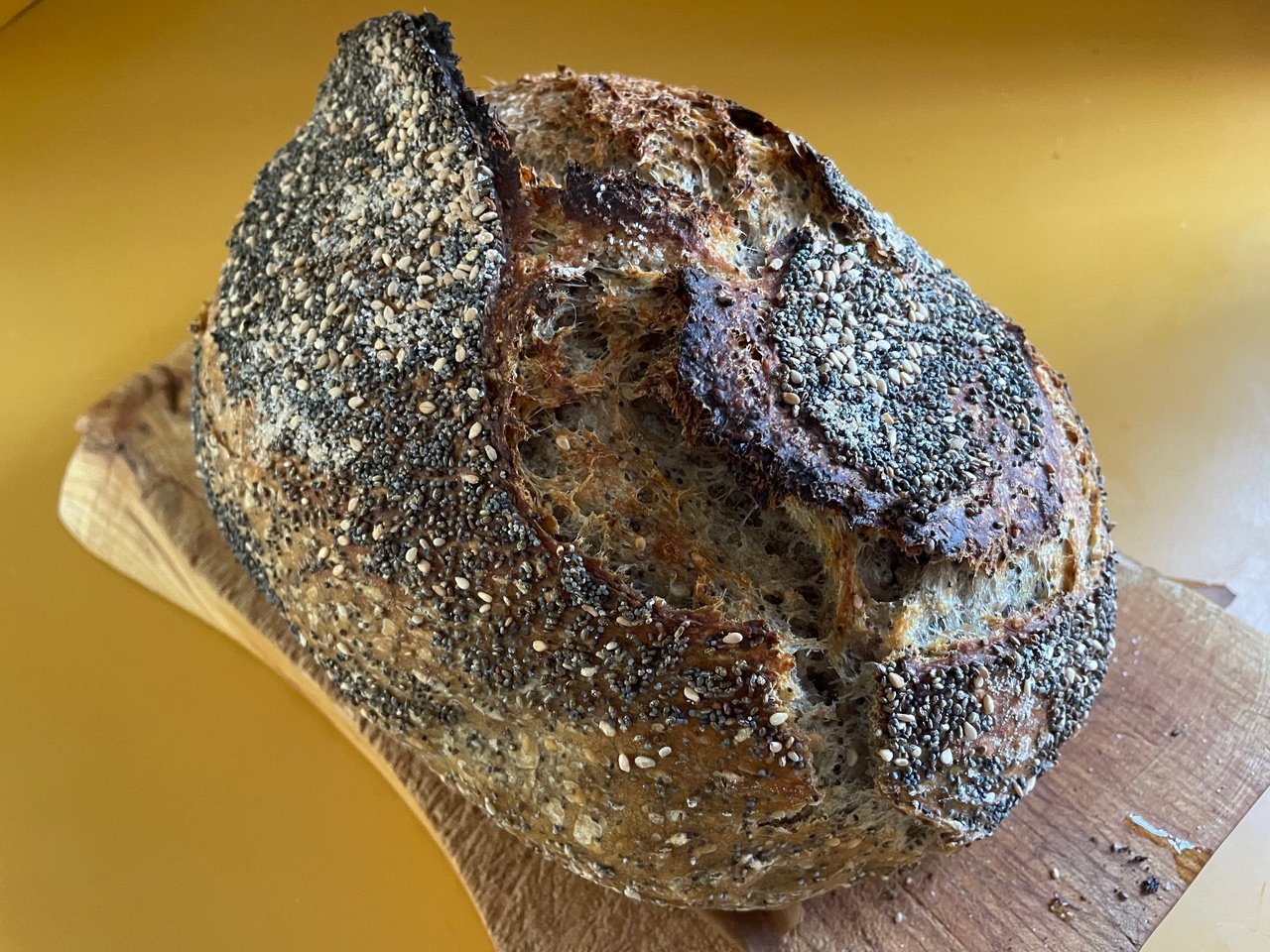
Seeded Sourdough
Adapting your favorite home bake
sourdough process with farmer ground flour
Adrian Sampson is a friend and hobbyist baker who has been baking with farmer ground flour for years with fantastic results. Here he shares his process and guidelines for working with our flour, and a link to seeded sourdough recipe that he has fallen in love with as of late.
My name is Adrian, and I'm a hobbyist sourdough bread baker in Ithaca. I use Farmer Ground stuff in basically everything I make: mainly, the high-extraction bread flour, all-purpose flour, and rye.
I *really* like the robust flavor that comes from baking sourdough with the FG bread flour. If you already have a recipe you like to make with standard white bread flour, using some or all of their "half-white" flour will kick it up a notch and make it a little more interesting and hearty. Doing this gives you similar results to recipes that explicitly call for mixing some whole-wheat and some more typical white bread flour. This bread flour is also what I use to build and feed my starter.
Relative to a white-flour-only base recipe, I usually have to slightly increase the hydration---maybe 10% or so---to get the texture about the same. This might just be my style, but I tend to just "eyeball" that increase: I'll start by weighing out the amount of water in the original recipe, see how the dough is feeling, and then gradually add a little more until it seems right.
I'm really in love with this seedy loaf recipe, and I think it's a particularly good match for using 100% FG bread flour. The chia seeds in particular add a fluffiness that can balance out the robustness of the flour itself.
For any sourdough bread, here's what I usually do:
I feed a levain ~12 hours before with a 2:1:1 ratio of flour, starter, and water. I then start with an "autolyse" phase, where you mix the flour and water only and let it rest for 20-60 minutes before continuing. (As an aside: This sounds simple, but it I find it makes a big difference in kickstarting the gluten development; you can immediately tell the difference when you come back to the dough after the autolyse period.) This initial flour-and-water mix is where I'll usually adjust things a little bit, adding somewhere between 30 and 50 grams more water. I like to do this case-by-case because I feel like it can depend on the season, the humidity, etc.---it's hard to describe exactly what texture I'm going for here, but it's something you can home in on over time.
I really recommend taking some of these notes and adapting them to this recipe from Breadtopia.
I hope it turns out well and you love it as much as I do!